- Best of Show: On Air Solutions Vertex.Framework
 On Air Solutions says Vertex.Framework is an operating model in which “algorithms and AI work alongside programmers and brand leaders to propose, analyze, prepare and enrich change.” Vertex is a module-based orchestration platform that connects production, music scheduling and distribution systems into a coherent operating layer. “Vertex translates leadership decisions into operational execution by structuring complexity across existing systems and teams, creating a scalable foundation without replacing what already works,” On Air states. “In a Vertex operation, algorithms and AI continuously analyze the programming, the market and the brand. They surface what has drifted, propose what should change and prepare the change in full — but they indicate rather than impose.” A programmer or brand leader sees what is proposed and why, and can confirm, adjust or decline. Proposals arrive shaped as a human would, “not as generic algorithmic output,” On Air says. AI-assisted and KPI-assisted edits are shown with their rationales. The human will know “why this song, not that one” because the system provided the answer. Also, where most broadcast operations run on multiple systems that each generate their own identifiers for the same song, asset or metadata field, Vertex bringds them together with a Global.Mapping layer. On Air says a small team now can govern an operation many times larger than headcount would otherwise allow without surrendering control of what airs. The framework works with MusicMaster Scheduling. Info: www.vertexframework.com The post Best of Show: On Air Solutions Vertex.Framework appeared first on Radio World. [TheTopNews] Read More.5 hours ago
 - FCC Honors Enforcement Bureau Trio With Engineering Award
 At the Federal Communications Commission’s September open meeting, Chairman Brendan Carr announced the recipients of the FCC’s 2026 Excellence in Engineering Award. The annual honor recognizes commission staff who make outstanding engineering, scientific or technical contributions. Nathan Bohne, Adam Wofford and Eric Krueger of the Enforcement Bureau share this year’s award for their work supporting the commission’s field offices. Specifically, the trio developed Project PERMIT, a system mandated under the PIRATE Act. Bohne serves as the Enforcement Bureau’s equipment develop group director. Wofford is an electronics engineer for the bureau, while Krueger is a software developer. PERMIT included an update of enforcement tools and field operations in support of the commission’s statutory responsibilities. The PIRATE Act prohibits landowners and property managers from aiding pirate radio operations. “The project exemplifies engineering innovation that delivers measurable, mission-critical impact across FCC operations,” the commission said. A selection committee for the award included leadership from two FCC offices. [See Our Business and Law Page] The post FCC Honors Enforcement Bureau Trio With Engineering Award appeared first on Radio World. [TheTopNews] Read More.13 hours ago
 - FCC Eases Environmental Policy for Communications Towers
 FCC Chairman Brendan Carr at the commission’s September open meeting. Credit: FCC As it marches onward in its push for deregulation, the Federal Communications Commission has voted to rein in its approach to National Environmental Policy Act regulations. The commission believes its action on Wednesday will cut billions of dollars’ worth of red tape and promote infrastructure investment. The vote, taken at its September open meeting, significantly revises its procedures for determining if constructing communications facilities, including broadcast towers, will affect the environment, according to those familiar with the changes. “(The new rules) will ensure NEPA serves as a tool for informed decision-making rather than a barrier to investment, innovation and connectivity,” the FCC stated in its announcement. Chairman Brendan Carr said all three branches of the federal government have acted to roll back “wayward” applications of NEPA. (Read the FCC’s report and order.) He cited Congress’ amending of the NEPA in 2023 to make it clear that the law’s environmental procedures apply to major federal actions only. “Today’s vote and related reforms are expected to save over $2 billion in compliance costs while zeroing out over $7 billion in economic harm,” Carr said. Major Federal Actions After the FCC originally included this draft in its September report and order, communications attorney David Oxenford wrote on the Broadcast Law Blog on Sept. 13 that the commission’s rollback would result in an environmental review process for broadcast activities only when the construction of a new tower requires an ASR. And so the commission clarified Wednesday that private wireless projects using geographic-area and site-based spectrum licenses do not constitute MFAs, or Major Federal Actions, provided they do not require an Antenna Site Registration. Carr and Commissioner Olivia Trusty voted to affirm the changes with the only Democrat on the commission, Anna Gomez, dissenting. According to the FCC, the rules adopted will: Determine that the actions associated with space-based operations, including the launch, deployment and operation of space stations, are not Major Federal Actions. Codify the statutory definition of MFA, the prerequisite to trigger federal agencies’ NEPA obligations in the commission’s rules and clarify which commission actions are MFAs. Outline that deployments of facilities in connection with geographic area spectrum licenses, site-based spectrum licenses, unlicensed or licensed-by-rule wireless services, and satellite earth stations do not qualify as MFAs to the extent the deployments do not require antenna structure registration. Revise the commission’s… [TheTopNews] Read More.13 hours ago
 - State Broadcasters Want the FCC to Ease Into Software-Based EASBroadcasters associations across America are in agreement over the benefits to software-based emergency alerting. But those benefits also shouldn’t jeopardize perfectly functioning hardware and risk, the associations believe, what makes the EAS system work in the first place. Associations that represent radio and TV broadcasters from 49 U.S. states expressed those sentiments in a joint filing to the Federal Communications Commission put forth by an attorney on their behalf. They support software-based EAS, but on a voluntary basis. The filing, submitted Sept. 29, pushed for flexibility, explaining that if a station’s hardware is working just fine, the station should be allowed to continue using it. The state associations frame their viewpoint under the stance that a solution suitable for a large TV broadcast group might not be suitable for a single radio station operator. (Read the joint broadcasters association comments.) “The commission therefore should allow each EAS participant to choose the certified hardware- or software-based solution that best fits its operations,” they wrote. The joint filing also concurred with prior comments from the National Association of Broadcasters that urged the commission to maintain the existing 60-day repair-or-replace period for software-based EAS, as well as to improve message authentication through a measured process. The FCC’s Further Notice of Proposed Rulemaking proposes to allow broadcasters and other EAS participants to use software to replace EAS hardware if they wish. The deadline for reply comments on the FNPRM was Sept. 29. The best fit To be clear, the associations see the the benefits of software-based systems. Endorsing NAB, the associations cited better support for remote updates, integration with current broadcast systems and reduced dependence on “purpose-built” hardware. But they emphasized those benefits should be realized without requiring stations to replace or discontinue use of a functioning hardware-based system. Software-based EAS should also satisfy performance, security and reliability requirements before it is used or marketed, the associations wrote. The commission should draw on manufacturer expertise in developing those requirements, they added, and permit routine maintenance, security patches and other updates without recertification. To that end, the associations also echoed the sentiments of NAB that the FCC should apply the existing 60-day period for repairing or replacing defective EAS equipment to software-based EAS, rather than a 72-hour deadline. That 72-hour window would discourage the use of such systems, the associations warned. The FCC should not assume that every software-related problem can be diagnosed and corrected… [TheTopNews] Read More.14 hours ago
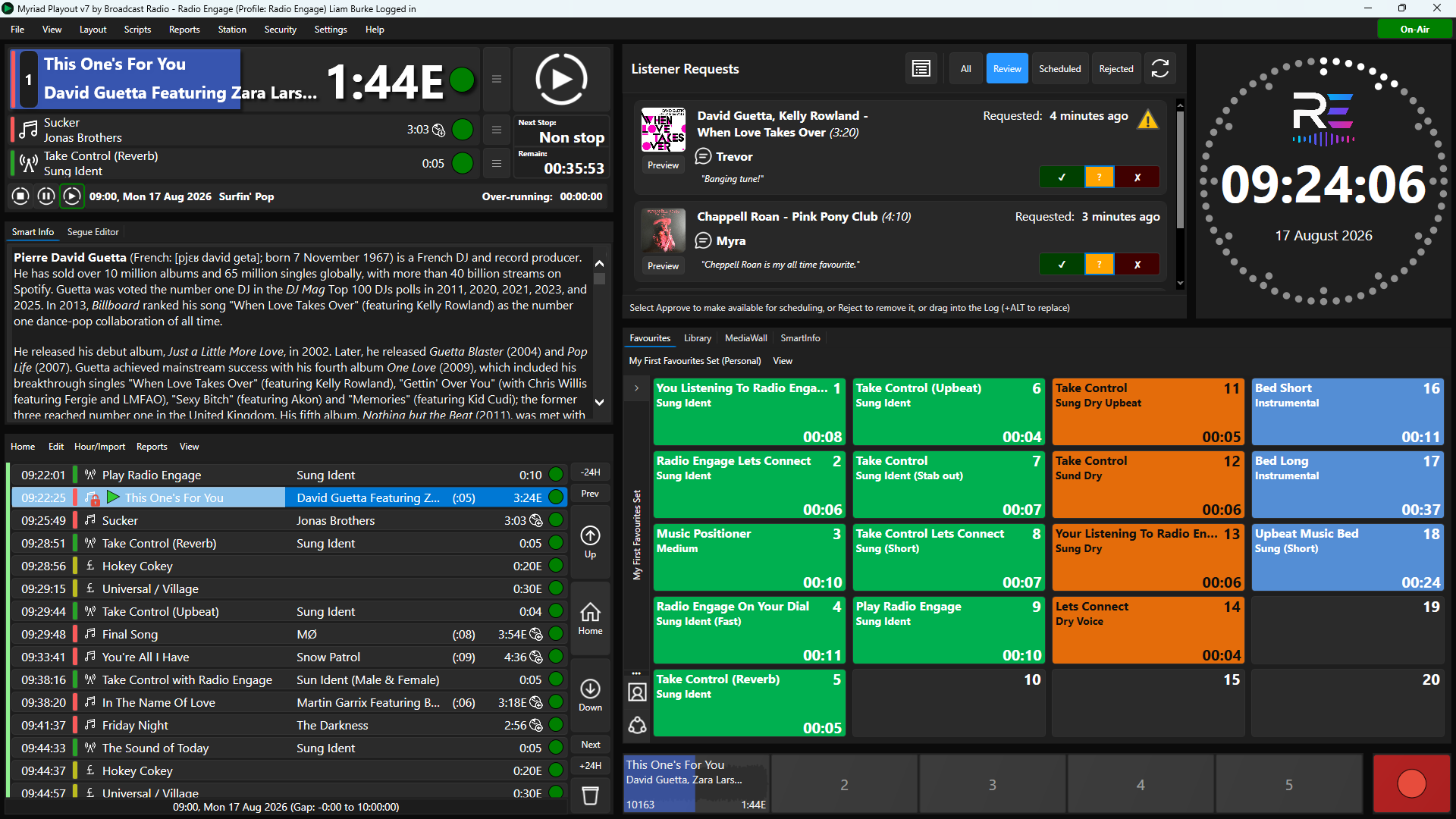
- Broadcast Radio Releases Myriad 7 Public Beta
 Broadcast Radio’s Myriad Playout 7 supports input of listener requests. Click to enlarge. Broadcast Radio has released the public beta of its Myriad Playout 7 software following a demo at the recent IBC Show in Amsterdam. The update introduces integrated listener engagement tools, including a request module that allows audiences to browse a station’s music selection and submit requests or messages to the studio. “Stations retain control over which songs are available and where requests can be accommodated within the log,” the company said. Added features include song voting, host and show management tools that allow stations to publish details about programs and on-air teams. The data then can be shared across Broadcast Radio’s other offerings and helps provide context for Myriad’s AI voice links. Since the initial announcement of Myriad 7, new additions include LUFS/R128 loudness normalization to help stations maintain consistent perceived loudness across their audio libraries. Stations can also design customized interface layouts tailored to specific hosts, programs and dayparts. The release also adds native support for the Elgato Stream Deck line, providing hardware controls for media playback, favorites, specific audio items and general studio functions. According to the company, Myriad 7 features a Windows 11-inspired interface, voicetrack placeholders and segue editor trim points. It also offers more flexible handling of audio beds, support for prerecorded programming, and refined clock editing and voicetracking for split-station operations. The full release of Myriad Playout 7 is scheduled for December. [Do you receive the Radio World SmartBrief newsletter each weekday morning? We invite you to sign up here.] The post Broadcast Radio Releases Myriad 7 Public Beta appeared first on Radio World. [TheTopNews] Read More.18 hours ago
RADIO WORLD – News | Radio-TV Industry News