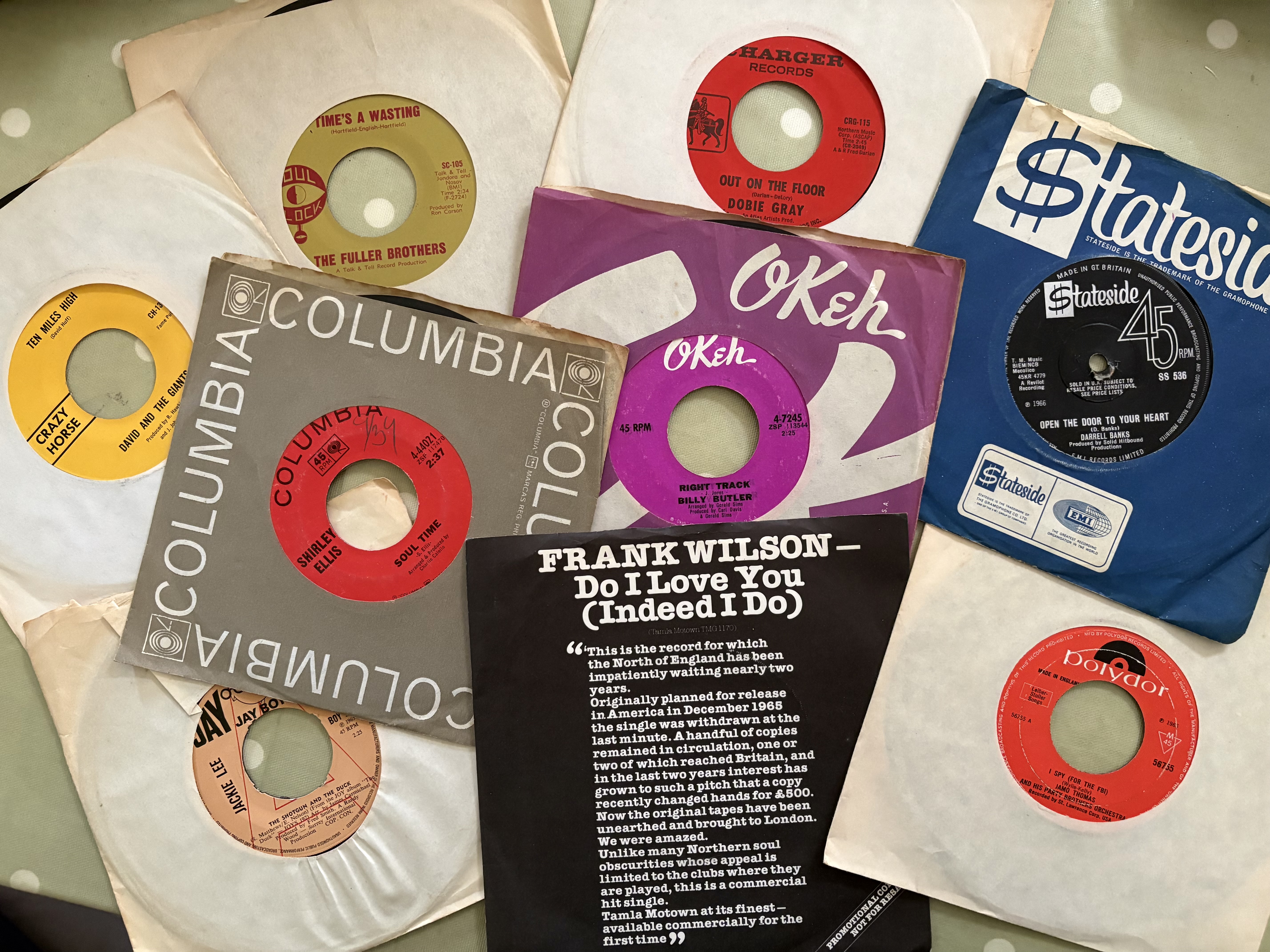

When I left Nottingham for London just before the end of the ’60s, Northern Soul was still in its embryonic stage. We’d danced to “I Can’t Help Myself”, “This Old Heart of Mine”, “You Don’t Know Like I Know”, “Helpless” and “Knock on Wood”, but something different was about to emerge from that club culture. On a visit back home in, I think, 1972, my friend David Milton — who had a shop in Derby called R. E. Cords — told me what it had become, after Dave Godin had given it a name in his Blues & Soul column. At Brian Selby’s Selectadisc, on long-gone Arkwright Street, I bought the Fuller Brothers’ “Time’s A Wasting” on Soul Clock and a bootleg of David and the Giants’ “Ten Miles High”. I’d pretty much stopped dancing by then, but although I was always at arm’s length from Northern Soul (no visits to the Torch in Stoke on Trent, Blackpool Mecca or Wigan Casino), it always exerted an emotional pull on me: geographical, tribal and musical. It reminds me of the wonderful Welsh word hiraeth: the longing for a home you may never have known. Northern Soul: Still Burning is a new 90-minute documentary film written and directed by Alan Byron, on show in cinemas this week. Against a constantly changing background of appropriate music, it consists mostly of talking heads — the disc jockeys (Richard Searling, Russ Winstanley. Ian Levine, Kev Roberts), the participants and the observers, including the journalist Paul Mason, who was both, the designer Wayne Hemingway, the documentary maker Tony Palmer, whose 1977 Granada TV film provides priceless footage from Wigan in 1977, and Elaine Constantine, whose feature film Northern Soul (starring Steve Coogan and Lisa Stansfield) came out in 2015 and also provides clips. From the contemporary scene, we hear from Ady Croasdell, who deejays all-nighters at London’s 100 Club, and two young chaps running Northern Soul nights in Deptford. And there’s Tony Blackburn, whose story of how he became an accidental Northern Soul star is the film’s comic highlight. But the principal concentration is on evoking the emergence 50 years ago of a social and cultural phenomenon in northern and midlands towns already feeling the blight of post-industrial decline through the closure of steel works, woollen mills and coal mines. The music itself is barely discussed: we don’t hear… [TheTopNews] Read More.
2 weeks ago