





Searchable News & Info From Reliable Online Sources.
- Legislative Compromises Pushed AM Radio Bill to House Passage
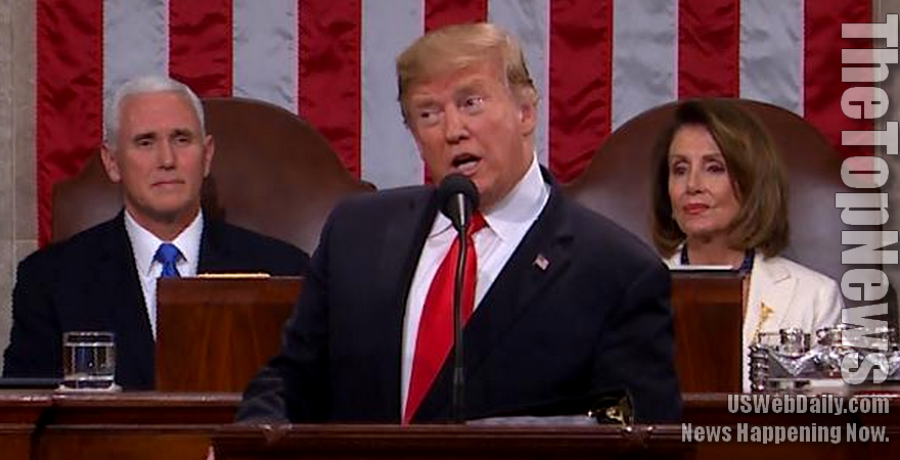
 The U.S. House floor on Tuesday. Credit: U.S. House Clerk The National Association of Broadcasters and other prominent players are celebrating Tuesday’s House vote in favor of the AM Radio for Every Vehicle Act. But the passage of the bill did involve some compromises. The radio industry admits it didn’t get everything it wanted when the original bill when it was first introduced. The bill includes a sunset provision of eight years instead of the 10 years originally proposed. In addition, the House’s Energy and Commerce Committee last fall added a requirement for the Department of Transportation to study any potential safety and innovation issues in regard to AM reception in new vehicles that feature autonomous driving systems, according to the text of the bill that you can view here. NAB acknowledged that changes were made to the final version of the bill. “Broadcasters have been open to hearing from lawmakers who had some concerns about the bill’s potential impact on automakers,” Carrie Healey, chief spokesperson for NAB, told Radio World. “The final legislation addresses those concerns, and we think that’s reflected in the overwhelming bipartisan support it received on the House floor (Tuesday).” The legislation requires the DOT to issue a rule within one year requiring AM radio capabilities to be standard in all new passenger vehicles sold in the United States. Next up, it will head to the Senate for its consideration. Sunset provision contingent on AM radio’s value After 40 minutes of debate on the House floor Tuesday, the amended bill passed by voice vote. U.S. Congresswoman Debbie Dingell used her time on the floor to speak about the compromises she gained for her constituency. The Democrat from Michigan is typically aligned with the auto industry on many issues. U.S. Congresswoman Debbie Dingell (D-Mich.) speaks on the House floor Tuesday. Credit: U.S. House Clerk As first reported by Inside Radio, Dingell called the bill a “strong compromise” after lengthy discussions with broadcasters, carmakers and lawmakers. “This bill mandates AM radio in every new car, but it also includes a sunset provision recognizing that Congress should reassess the mandates as technology evolves,” Dingell said on the floor. “If AM radio continues to provide value in the future, Congress can and should act again,” she continued. But Dingell also told lawmakers that 99% of the 286 million vehicles currently on U.S. roads have AM and approximately 90% of new vehicles continue to… [TheTopNews] Read More.3 days ago
 - Why are there concerns AI could threaten humanity, and how real are they?
 Existential fears about AI have once again reared their head - here's what you need to know. [TheTopNews] Read More.3 days ago
 - 5 Ghost Towns to Explore This Fall
 These mostly abandoned wilderness outposts, resplendent in their solitude, invite curious visitors to imagine what life was like during the boom times. [TheTopNews] Read More.3 days ago
 - After the Gold Rush: 5 Ghost Towns to Explore This FallThese mostly abandoned wilderness outposts, resplendent in their solitude, invite curious visitors to imagine what life was like during the boom times. [TheTopNews] Read More.3 days ago
- Woody Guthrie in Soho
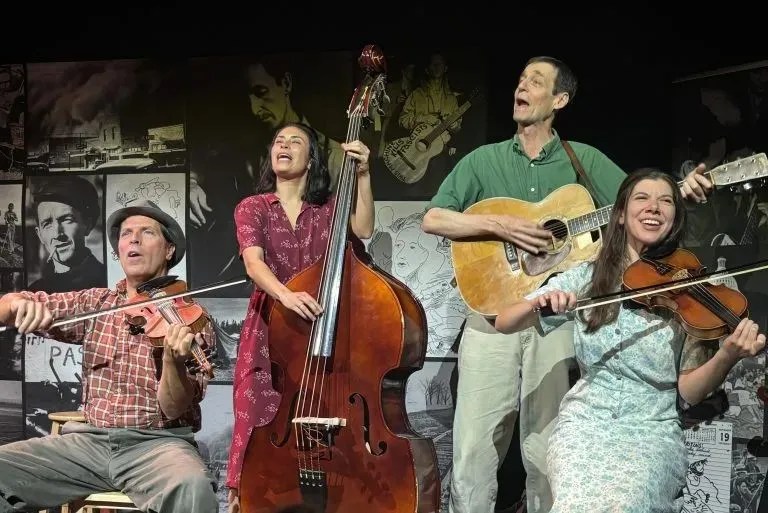
 At a few minutes after eight o’clock last night, in an upstairs theatre on a Soho alley, you’d have had a job persuading me that Woody Guthrie’s “Deportee (Plane Wreck at Los Gatos)” is not the greatest song produced by the 20th century. Its performance came towards the end of Woody Sez, a stage show devoted to the life and work of the great poet-troubadour of America’s working class. David M. Lutken, a Texan actor-musician who once studied in London, devised the four-person show (with its director, Nick Corley) and was playing the part of Guthrie, his lean frame and likeable delivery making him a good fit. “Deportee”, which Guthrie wrote in 1948 after reading a newspaper report about the crash in California of a plane in which 28 migrant farm workers were being deported back to Mexico, was sung as a duet with Raquel Chavez, and I don’t think I’ve ever heard a more affecting version. But it wasn’t alone as a highlight of the evening. With Lutken delivering Guthrie’s story as a between-songs first-person narrative, we were also treated to rousing versions of “Pastures of Plenty”, “Ain’t Got No Home”, “This Train Is Bound for Glory”, “Jolly Banker”, “Vigilante Man” and several others, with “This Land Is Your Land” delivered as a closing singalong. Chavez, Nyssa Grant and David Finch took occasional lead vocals and sang harmonies while switching between a variety of instruments: duelling fiddles, mandolin, dulcimer, autoharp, string bass, penny whistle, spoons, harmonica, Jew’s harp, banjo, six- and 12-string guitars and a dobro. Their deftness and enthusiasm, and some clever stage movement, ensured that the 80-minute show never dragged. “Deportee” may have moistened the eyes, but elsewhere there was a lot of humour and fun. It was good to be reminded of a key source of inspiration for Bob Dylan, Ry Cooder, Bruce Springsteen, Rhiannon Giddens and many more, and also of the need for resistance in times when the greed and cruelty of the vigilantes and the jolly bankers threaten the common good. * There are further performances of Woody Sez tonight, tomorrow and Saturday (17-19 September) at Underbelly Boulevard Soho, 6 Walker’s Court, London W1F 0BT: underbellyboulevard.com [TheTopNews] Read More.3 days ago
 - The Case for a Shadow Court
 One dismal morning in January 2001, I strode into a University of Oregon classroom to face 90 fresh-faced first-year law students. I had the unenviable task of explaining the “law” behind Bush v. Gore, decided a month earlier. It was an impossible task. What could I say to these legal novices, beyond “It is not too late to reconsider the life choices that brought you here”? There was no explanation for Bush v. Gore other than the obvious: The Supreme Court took the election away from the people because five of its members didn’t like Al Gore. No decision in my lifetime has shown such contempt for the law or so consciously torn a catastrophic hole in the self-governing institutions the Constitution supposedly aims to sustain. Even today, a quarter-century after the Court’s worst blunder since Dred Scott, no explanation fits the ruling into the fabric of American constitutional law. Instead, lawyers, scholars, and judges have treated this travesty as a human body treats a foreign object trapped in a wound. It is not incorporated but encysted: surrounded by protective tissue that limits the damage and pain. Constitutional law basically passes over this crucial decision by refusing to talk about it. Back in 2001 I would have welcomed the chance to offer my students a careful, clear explanation, written by credible constitutional lawyers, of exactly what was bogus about the decision—not because Gore should have won but because, by stepping in to stop a state-court recount on the flimsiest of grounds, the Court was doing something it had no business doing. Yet when a useful rebuttal was most needed, no one stood forth with one. As a result, the Court that flowed out of the case has largely paid no price in authority or prestige. The Shadow Court: Rescuing Democracy from the Supreme Court by Julie C. Suk. University of California Press, 312 pp. In The Shadow Court, Fordham University Law Professor Julie C. Suk offers a mechanism that (in my fond imagination) could have filled this vacuum—and could fill others if they arise. Her proposal has many virtues: It is entirely legal, requires no amendment to the Constitution, and might very well help rebuild the national commitment to democratic self-government that has been undermined since Bush v. Gore. But before we get to her solution, let’s begin with the problem(s): Generations of American… [TheTopNews] Read More.3 days ago

The Searchable USWebDaily.com and TheTopNews NewsBank Helps You Be Better Informed, Faster! Spread The Word.