








Searchable News & Info From Reliable Online Sources.
- Rail excursion
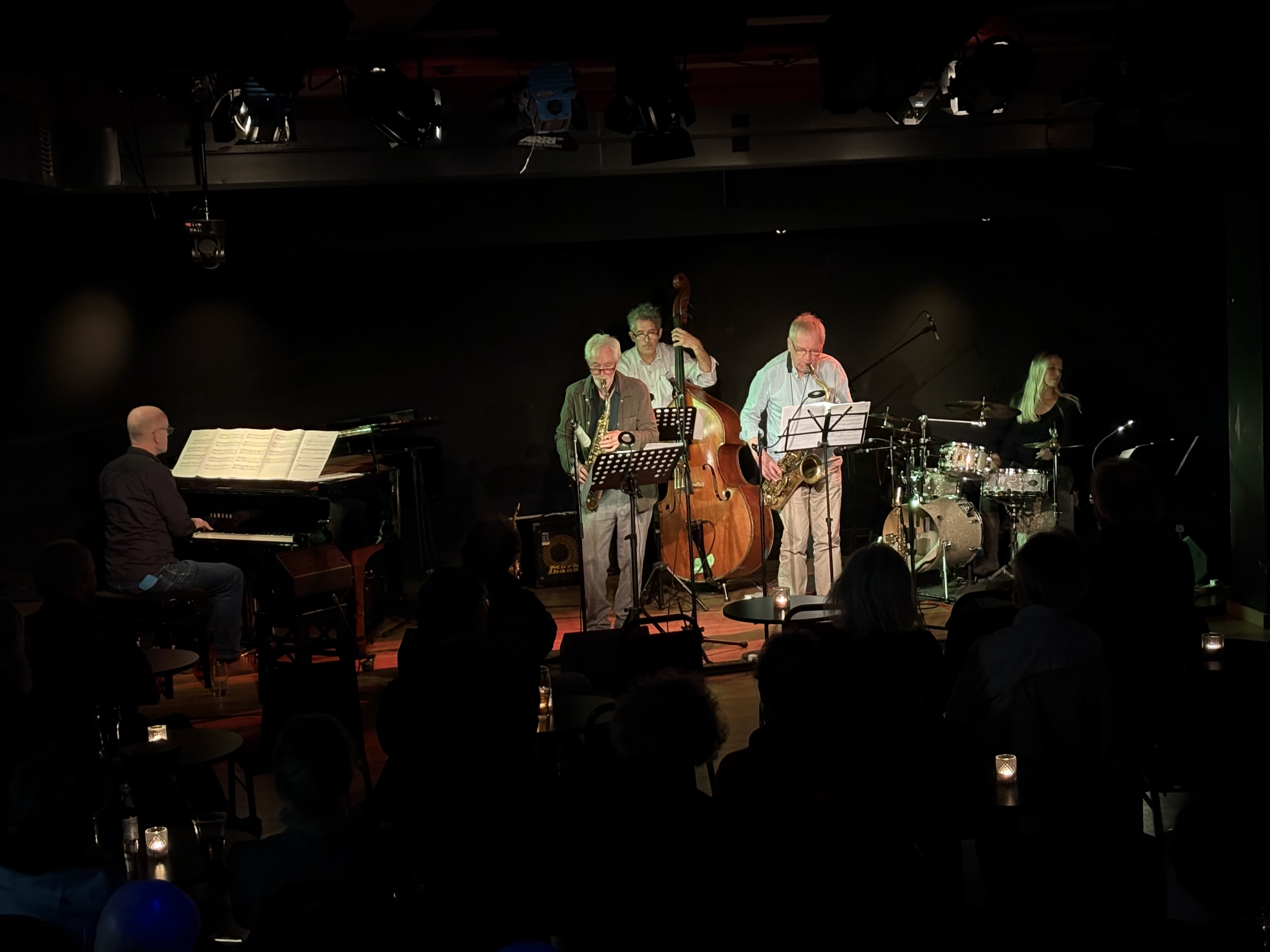
 Not often do I begin a review with a recommendation for the venue’s catering. In fact never, until now. But the Jazz Café POSK, situated in London’s Polish cultural centre on King Street in Hammersmith, extends a hospitality that includes its restaurant, where before last night’s gig by the Wobbly Rail Five I had a plate of herring with potato salad and a large slice of apple pie with cinnamon — all delicious — and came out with change from 15 quid. In his days as a college radio DJ, Lou Reed titled his programme Excursion on a Wobbly Rail, after a tune on Cecil Taylor’s 1959 LP Looking Ahead. Ten years ago Wobbly Rail Five became the name of an occasional quintet fronted by the British saxophonists and long-time associates Chris Biscoe and Pete Hurt, with Liam Noble on piano and Steve Watts on bass. When they made an album in 2016, it was with Jon Scott on drums. Last night at POSK the drums were in the hands of Sophie Alloway. It’s an interesting little group, playing quite intricate compositions that require sheet music and fairly intense concentration, occupying a part of the jazz spectrum also inhabited by Thelonious Monk and Herbie Nichols. Last night’s repertoire, based on the album, included Monk’s “Played Twice” (arranged for two sopranos, as if in homage to the group the late Steve Lacy once led with a second soprano, Steve Potts), along with pieces by Biscoe, Hurt and Noble, most of them including a nod to the high priest of bebop somewhere in their contours. Noble is particularly good at that kind of thing, and his solos were notable for the strength of their angular architecture. Alloway responded brilliantly to the challenge of providing the detailed arrangements with the sort of cues and punctuations more normally required in a big band than a small combo, while retaining the intimacy of the conversation, swinging beautifully along with Watts and adding particularly effective cymbal textures. Irregularly assembled, the band sounded a little stiff to start with but eventually eased into the evening in front of a smallish but enthusiastic audience, the horns warning up with Biscoe’s liquid soprano on Hurt’s woozy ballad “Lost for Words” and Hurt’s tenor digging into the contours of Noble’s “Ask Your Mother”, which bopped along like a soul-jazz tune with a dash of… [TheTopNews] Read More.3 weeks ago
- A vote of confidence
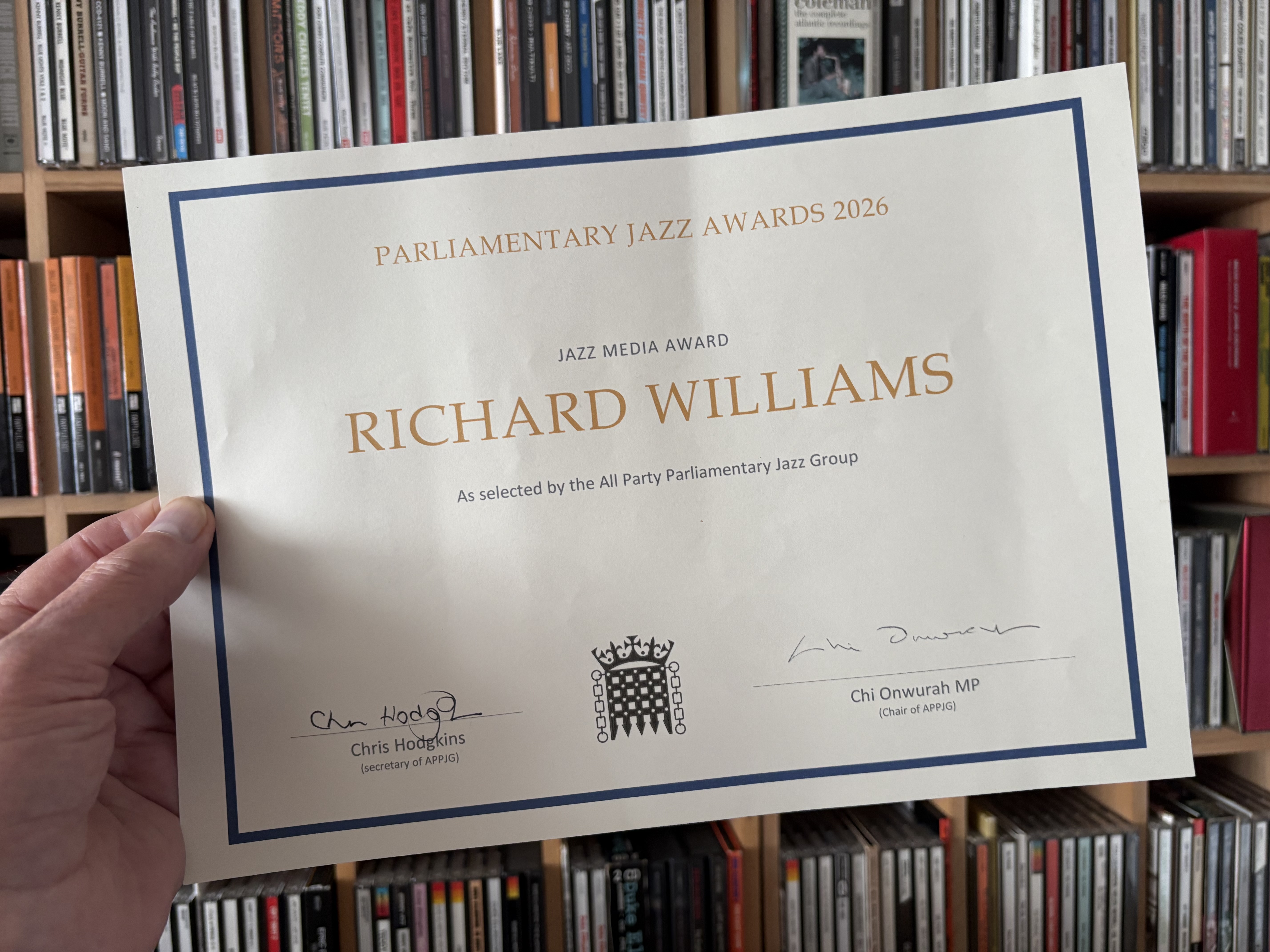
 Last night I was honoured to be in the company of Yazz Ahmed, Donovan Haffner, Knats, Heidi Vogel, Iain Ballamy, Olivia Cuttill, Jean Toussaint and others as recipients of the 2026 Parliamentary Jazz Awards. The event took place at World Heartbeat, a venue close to the new US Embassy in Nine Elms. It was the 21st year of the awards, given by the All Party Parliamentary Jazz Group, and I was delighted to be given the Jazz Media Award. As one does, I gave a short acceptance speech in which I said that 64 years ago, aged 15, I came runner-up in the Daily Telegraph‘s Junior Jazz Critic competition, and I’ve been trying to do better ever since. The Telegraph‘s senior jazz critic at the time was Philip Larkin, a great poet but a very iffy jazz critic: enthusiastic about the early stuff in a duffel-coat-and-college-scarf sort of way, he detested almost anything modern (sample phrase: “the passionless creep of a Miles Davis solo”). He was one of those critics who decided pretty early on that things aren’t what they used to be. That, I said, is not how I feel. Things are tough for anyone who chooses to play jazz for a living, particularly in cash-strapped Britain, where libraries and humanities courses are under threat, but the music itself is thriving, particularly among young players. When it comes to signs of life, I could give lots of examples, but the one I chose was this, and it came to me last week, on a evening when I heard Melissa Aldana, the Chilean saxophonist, at the Wigmore Hall after spending the day writing a sleeve note for the next album by the Welsh saxophonist Rachel Musson, both wonderful improvisers. Sixty-odd years ago, when I was devouring the Melody Maker and Down Beat in order to learn about this music, the names of only two female jazz saxophonists ever cropped up. One was the British tenorist Kathy Stobart, the other the American altoist Vi Redd, both useful players. After that, in the ’70s, there was Barbara Thompson. Now, though, I could name you 30 or 40 world-class female jazz saxophonists without pausing for breath. And the same is true for other instruments. Anyway, it was nice to get the piece of paper, and I’m grateful to the people who organise the awards, which are undoubtedly a good thing… [TheTopNews] Read More.3 weeks ago
- Inflation Worsened Last Month To 3.7% In Sign That Prices Remain High As Midterm...
 On a monthly basis, costs jumped 0.6% from August to September, the biggest gain in five months, up from a 0.4% increase the previous month. [TheTopNews] Read More.3 weeks ago
- Acrobatic, goofy and super-fast: the biama battles redefining Ivorian dance cult...
 Fuelled by TikTok and street dance battles, the coupé-décalé offshoot is latest expression of Côte d’Ivoire’s pop cultureThe 400-strong crowd, perched on plastic chairs and wooden benches in Abidjan’s Yopougon-Selmer neighbourhood, roared with approval as Sauce Graine twisted and turned on the spot with breathtaking speed and dexterity.The dancer, named after the Ivorian palm nut delicacy, was competing in a series of street dance battles set to biama, a frenetic offshoot of coupé-décalé, a type of percussive dance music popular across west Africa that originated in Côte d’Ivoire around the turn of the century. Continue reading... [TheTopNews] Read More.3 months ago
- Athlete blames burrito for four-year banShelby Houlihan says she has been banned for four years after testing positive for a prohibited substance - which she blames on a burrito. [TheTopNews] Read More.5 years ago
- Scaleway launches Mac mini cloud instancesCloud hosting company Scaleway is adding a new type of instances today — Mac minis powered by Apple’s M1 chip. The new instances cost €0.10 per hour, around $0.12 at today’s rate — there’s a minimum commitment of 24 hours. Scaleway is hosting those new computers in its DC4 data center in Paris — it’s a former underground nuclear fallout shelter. Right now, the Mac minis aren’t available in the company’s other data centers in Amsterdam or Warsaw. When you boot up a Mac mini from the console, you get an entry-level Mac mini with 8GB of RAM, 256GB of SSD and macOS Big Sur. And of course, it uses Apple’s first Arm-based chip, the M1. After that, you can connect to the instance using VNC — you’ll see the desktop environment and you’ll be able to use it like a normal Mac. You can also connect to the instance using SSH directly in case you only need a command line interface. Scaleway isn’t the first company to offer Mac mini instances. Amazon Web Services recently launched its own Mac mini instances, but they rely on Intel i7 CPUs and costs $1.083 per hour — or $26 for 24 hours. The company will likely roll out M1 minis at some point in the future. There are also several Mac-focused hosting companies out there, such as MacStadium, MacinCloud, MacWeb and Mac Mini Vault. An M1-powered Mac mini with 8GB of RAM and 256GB of storage currently costs $109 or €109 per month on MacStadium — that’s slightly more expensive than Scaleway. If you keep a Mac Mini instance for 30 days on Scaleway, it costs €72 (or $87 at today’s rate). You can use Mac servers for development purposes, and specifically for continuous integration and delivery. Building an iOS app requires a Mac. You can’t just build the app on an Ubuntu server. So if you want to build your app on a server, you have to rent a Mac. But you may have different use cases for a Mac server. You might want to use it to test your macOS app on Apple silicon before releasing it. Or you might just want to play around with the M1. [TheTopNews] Read More.6 years ago

The Searchable USWebDaily.com and TheTopNews NewsBank Helps You Be Better Informed, Faster! Spread The Word.